
There is a version of having high standards that feels alive. You care about your craft, you want to improve or refine because something in you is engaged.
And then there is the version that never lets you settle.
In Schema Therapy, Jeffrey Young describes Unrelenting Standards as a pattern organized around an internal rule: you must meet very high standards of behavior and performance, usually to avoid criticism. Over time this produces chronic pressure, difficulty slowing down, and hypercriticalness toward yourself and often toward others. Its a pattern that make pleasure decrease, relaxation feel undeserved and accomplishments never get to really sink in. Relationships can become strained by rigidity or evaluation.
What a Schema Is
A schema is a stable, deeply ingrained pattern that develops in childhood and continues elaborating itself throughout life. We interpret the world through these patterns. They are core beliefs and emotional conclusions about ourselves and our environment that we accept without questioning.
Schemas are self-perpetuating. They filter experience in ways that confirm themselves. Even overwhelming success is often insufficient to dislodge them. A person can achieve extraordinary things and still feel inadequate if the underlying structure insists they are never enough. The schema protects its original conclusion.
Most of the time, schemas operate quietly. They sit in the background shaping perception. When triggered, however, they can dominate thoughts and emotions. The intensity of the reaction often feels disproportionate because it is not only about the present moment. It is the older pattern resurfacing.
Unrelenting Standards is one of these patterns.
How Unrelenting Standards Presents
It frequently appears as perfectionism or an inordinate attention to detail. There may be a persistent underestimation of your own performance relative to the norm. The internal bar is set higher than the room.
Rigid rules and “shoulds” often extend beyond work. They can organize morality, parenting, health, spirituality, cultural expectations, even how one is supposed to feel. The standards may sound ethical or principled. They feel non-negotiable.
There is often preoccupation with time and efficiency. A sense that you should be accomplishing more. Slowing down can feel irresponsible. Rest can carry guilt.
The underlying assumptions tend to be blunt.
I have to be perfect.
I need to do more.
I can’t accept good enough.
And this pattern is not limited to productivity. It may attach to appearance, emotional composure, likability, or reputation. You are not only trying to do well. You are trying to remain acceptable.
How It Forms
Unrelenting Standards develops within relationships.
In some families, approval intensifies with achievement, success brings warmth. and mistakes bring tension or subtle withdrawal. The child does not need an explicit message…the pattern is enough.
In other homes, one or both parents model relentless striving themselves. Productivity equates to virtue, whereas, falling short invites criticism. The high expectations dominate the emotional climate of the home.
Caregivers may use shame or sharp correction when standards are not met. Excellence becomes a way to reduce the risk of humiliation or distance.
A child learns quickly what keeps connection. In this case, meeting high standards stabilizes closeness and achievement becomes a protective factor.
In homes where a caregiver is overwhelmed or emotionally inconsistent, a child’s competence can calm the atmosphere. Being impressive reduces tension and reduces conflict. Over time this starts feeling like identity.
The Link to Grandiose Shame
Unrelenting Standards often overlaps with grandiose shame. You can read more in the shame blog, but the structure is important here.
Grandiose shame is confusing because it can look like confidence, pride, or excessive praise. Structurally, it still organizes around shame.
The message is rarely “you are bad.” It is more often “you must be exceptional to be acceptable.”
In these dynamics, a parent’s admiration may be less about the child as a separate person and more about what the child represents. The child becomes an extension, a mirror reflecting “extraordinary” back to the parent. Ordinary begins to feel unsafe and average feels humiliating.
Over time, this produces a split internal experience. One part carries the inflated expectation. Another part knows the limits of being human. When reality inevitably reveals those limits, the reaction is not simple disappointment. It can feel like exposure.
There is often relational emptiness underneath grandiose praise. If a caregiver only engages with the “amazing” version of the child, then the child learns that vulnerability, confusion, and struggle are not welcome. They are admired but not known.
That misattunement is deeply shaming.
Clinically, this can show up as compulsive perfectionism, sharp collapse when not performing at a high level, or a chronic sense of fraudulence despite success. Realistic feedback can feel less like guidance and more like being unmasked.
In Michael Stadter’s framing of shaming others, the grandiose shaming other does not shame through overt criticism. They shame through unrealistic elevation and neglect of reality. The child is set up for shame later because they are never helped to integrate limits with grounded worth.
When this dynamic fuses with Unrelenting Standards, excellence becomes the condition for acceptance and belonging.
How It Shows Up Now
In adulthood, the pattern may look like finishing something and immediately shifting to the next task without satisfaction. Struggling to relax without guilt. Monitoring your body, tone, or reactions. Replaying conversations or feeling a drop in self-worth after minor mistakes.
Even significant success does not resolve it. The standard adjusts, then the relief fades and the pressure returns. This is how schema patterns sustain themselves.
A Softer Understanding
Inside every schema is a younger version of you who was trying to survive something overwhelming.
Rejection, embarrassment, abandonment, or relational harm may have felt intolerable. A solution formed: be better, impressive, stay composed and stay ahead. The child was not pursuing excellence for status and they were protecting connection. The strategy worked in that environment, but it does not have to define your present.
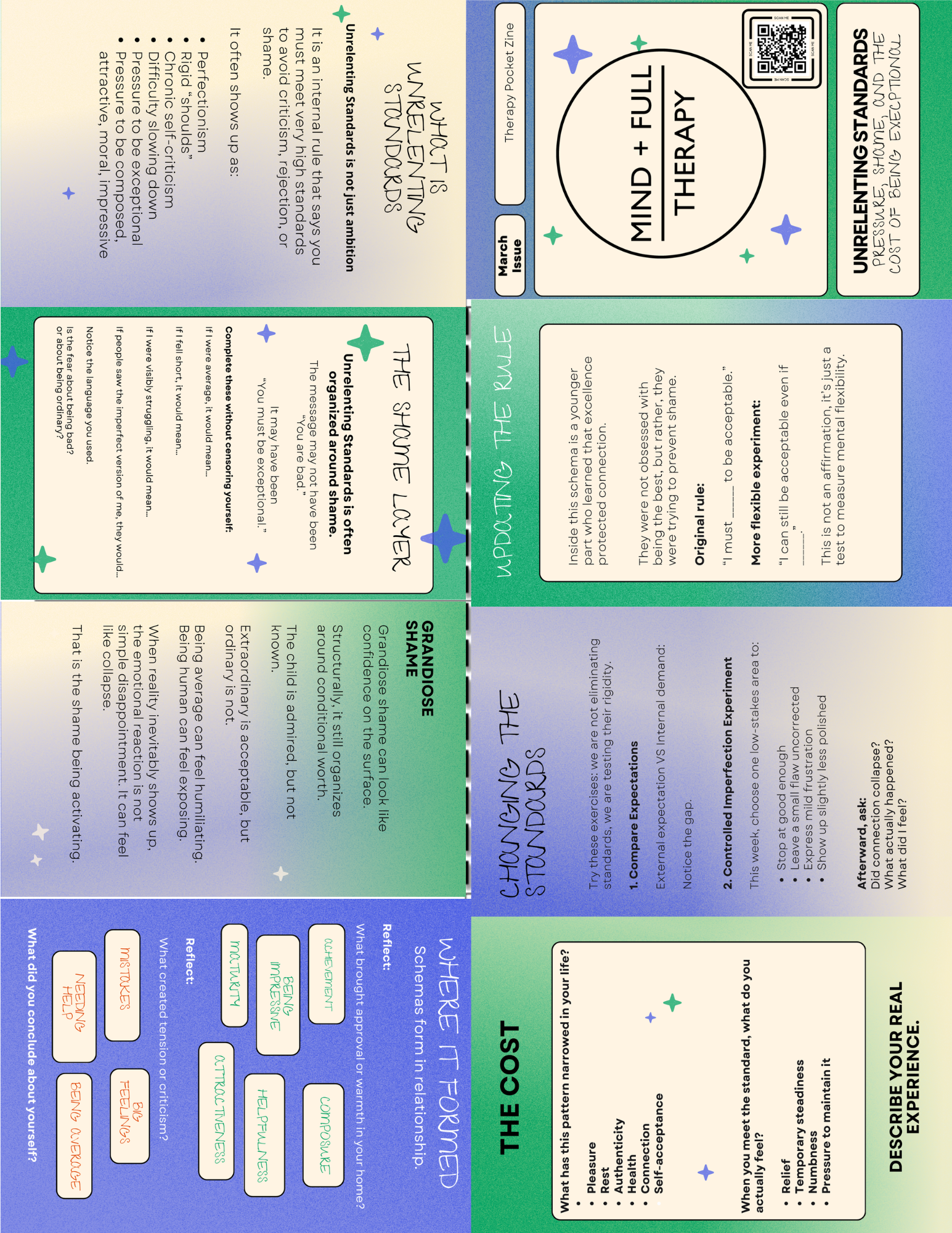
You can download the therapy pocket zine on Unrelenting Standards to assist in guiding and help you explore the internal rules and the same that often is underneath them.
Working With This at Mind+Full Therapy
At Mind+Full Therapy in Salt Lake City, we work with adults who are exhausted by internal pressure around productivity, image, and emotional control.
Schema therapy helps map the pattern so it feels less like personality and more like history. Inner child work brings attention to the younger self who first carried the rule. EMDR, Brainspotting, and Accelerated Resolution Therapy can process moments where shame and conditional approval became encoded. Internal Family Systems allows protective parts and wounded parts to be understood rather than fought. Comprehensive Resource Model and other experiential approaches work with the embodied memory of early relational environments.
The aim is not to eliminate drive. It is to loosen the link between worth and performance so that striving becomes choice rather than requirement.
If you are in Utah and recognize yourself in this pattern, therapy can be a place to approach it with more clarity and less self-attack.
You do not have to keep earning your place in the room.