
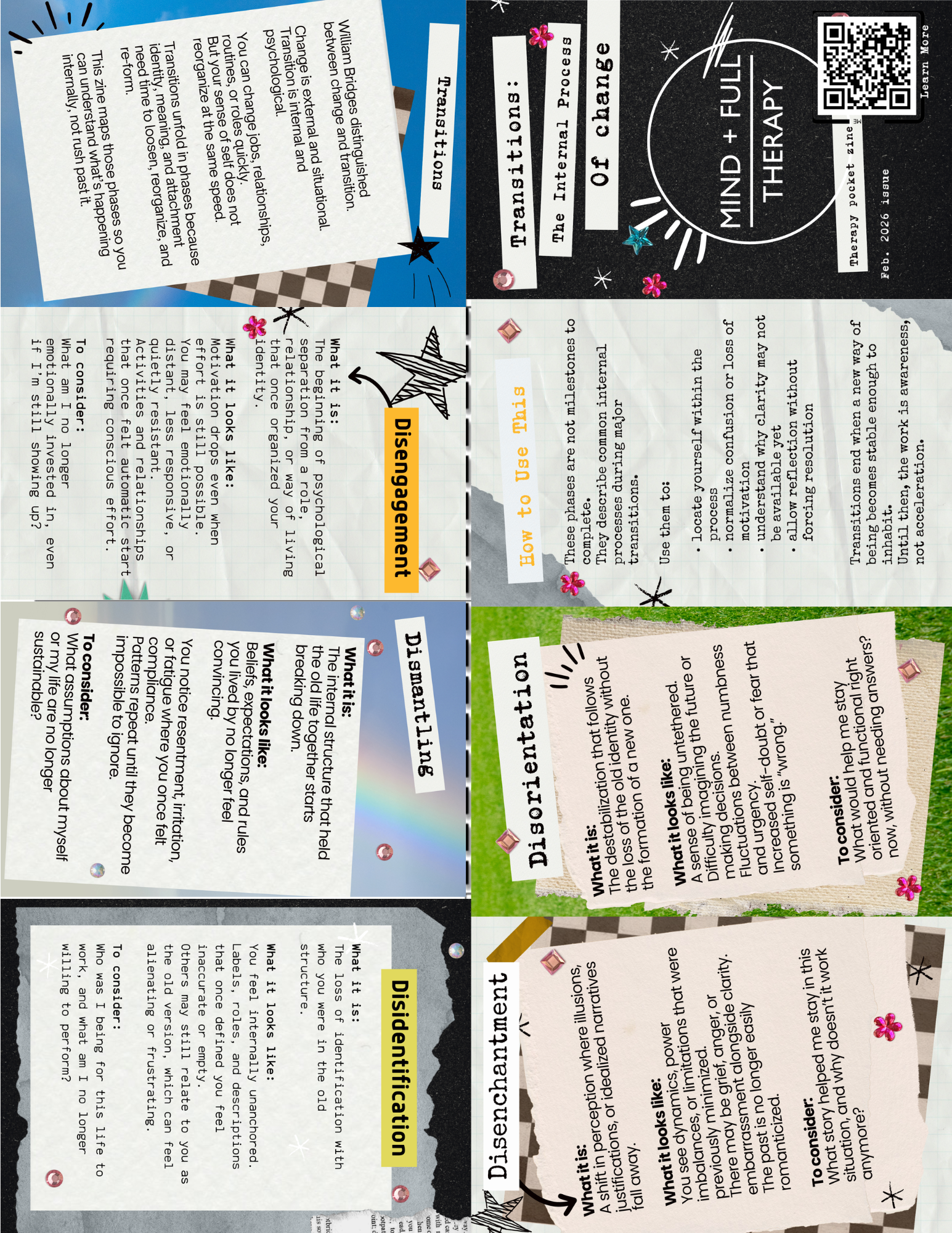
The Phases of Life Transition: (downloadable pocket zine)
Most people think change is the hard part. Ending a relationship. Leaving a job. Walking away from a faith tradition. Realizing the way you’ve understood yourself no longer fits. What tends to destabilize people more is what happens internally around those changes.
William Bridges made a useful distinction that still holds up. Change refers to external events and circumstances. Transition describes the internal process of psychological adjustment that follows, or sometimes begins long before, those events.
People often assume they should feel motivated, certain, or relieved once a change happens. When that doesn’t occur, they conclude something is wrong with them. Often, they are simply in a phase of transition they don’t recognize.
Bridges observed that transitions tend to move through recognizable phases, not because people are linear, but because identity, meaning, and attachment reorganize over time.
Disengagement
Disengagement is the beginning of psychological separation from something that once structured your life.
In a faith transition, this often looks like quietly pulling back before any public decision is made. You may stop praying the way you used to, skip services, or feel emotionally flat during rituals that once felt meaningful.
In a relationship, disengagement can show up as less effort to repair, less urgency to explain yourself, or a growing sense that you are already halfway gone emotionally.
In a job, you may still perform your tasks competently while feeling oddly detached from outcomes you once cared deeply about.
In terms of self-concept, disengagement often appears as a subtle discomfort with old descriptors. “I’m just anxious.” “I’m the responsible one.” “I’m the problem.” These labels start to feel thin or inaccurate, even if you can’t yet articulate why.
Disengagement is not indifference. It’s the psyche creating distance from something that no longer fits.
A useful orienting question here is: What am I no longer emotionally invested in, even if I’m still participating?
Dismantling
As disengagement continues, the internal structure that supported the old life begins to break down.
In a faith transition, beliefs that once felt foundational start to unravel. You may notice contradictions you previously ignored, or feel irritation where there was once reverence.
In a relationship, this phase often includes replaying arguments with new clarity. Patterns become visible. You may feel resentment about compromises you once framed as love.
In a job, dismantling can look like questioning norms you once accepted without thought. Long hours, unclear boundaries, or power dynamics that once felt “normal” now feel costly.
At the level of core beliefs, dismantling often shows up as a loss of certainty. The rules you lived by stop working. “If I do everything right, I’ll be okay.” “If I’m good enough, I won’t be abandoned.” These assumptions begin to collapse under scrutiny.
This phase is uncomfortable because it exposes the cost of the old structure.
A helpful reflection here is: What assumptions about my life or myself are no longer sustainable?
Disidentification
Disidentification is the loss of identification with who you were in the old structure.
In a faith transition, this might look like no longer recognizing yourself as a “believer,” even if you haven’t adopted a new framework yet. The old identity no longer fits, and there’s nothing to replace it.
In a relationship ending, this can feel like losing the version of yourself that existed only in that dynamic. You may ask who you are without being someone’s partner, caretaker, or stabilizer.
In a job transition, disidentification often shows up when your role was closely tied to your sense of worth. Without the title or function, you feel unanchored.
With self-perception, this phase is often marked by a sense of blankness. Old labels don’t land. Compliments feel off. You may feel unfamiliar to yourself, while others continue to relate to you as the old version.
This phase isn’t about finding a new identity quickly. It’s about noticing what you are no longer willing to perform.
A grounding question here is: Who was I being to make that life work, and what am I no longer willing to carry?
Disenchantment
Disenchantment is the shift in perception where old narratives stop working.
In a faith transition, this might mean seeing the institution or belief system without the protective framing you once needed. There may be grief for what it gave you, alongside anger for what it cost.
In a relationship, disenchantment often involves seeing the limits of what the relationship could realistically provide, rather than what you hoped it would become.
In a job, this can look like recognizing that loyalty was not reciprocated, or that advancement required sacrifices you no longer accept.
In terms of core beliefs, disenchantment often arrives when you realize that a belief helped you survive at one point, but is now restricting your life. The belief loses its emotional credibility.
Grief, anger, and clarity often coexist here.
A useful reflection is: What story helped me stay, and why can’t I believe it anymore?
Disorientation
Disorientation follows the loss of the old identity without the formation of a new one.
After a faith shift, people often describe feeling spiritually unmoored, unsure how to orient to meaning or morality.
After a relationship ends, the future may feel blank rather than open. Decisions feel heavier. Even small choices can feel exhausting.
After leaving a job, especially one tied to identity, people often report feeling untethered, even if the departure was chosen.
With self-concept, disorientation can include self-doubt, fear of regression, or a sense that something is wrong because clarity hasn’t arrived yet.
What’s missing here is structure. Structure once provided orientation, and it is temporarily gone. This is not a phase for solving your life. It’s a phase for staying oriented enough to keep going.
A practical question here is: What do I need right now to stay grounded through the day without needing answers?
The Neutral Zone
Bridges referred to the space between endings and beginnings as the neutral zone.
This phase often includes emptiness, reduced direction, and fewer external demands. It can feel uncomfortable precisely because there is less structure. When the old structure is gone, there’s more room to think clearly.
People often notice what they don’t miss. What actually felt relieving to let go of. What they no longer want to organize their life around.
This is where self-exploration happens through observation, not reinvention. You learn by paying attention to what feels easier, harder, or unnecessary now.
Taking time here matters.
The neutral zone prepares the ground for a beginning that is authentic and not merely reactive. When the neutral zone is rushed, people often rebuild the same life in a new form.
Using the Framework
The phases of transition are not steps to complete. People often move back and forth between them. Multiple phases may be present at once.
This framework is useful because it replaces self-judgment with orientation. Instead of asking what is wrong with me, you can ask where am I in this process.
Transitions resolve when a new way of being becomes stable enough to inhabit. Until then, the work is noticing, reflecting, and allowing the internal shift to take shape without forcing conclusions.
If You’re In a Transition
Transitions are easier to move through when you don’t have to interpret them alone.
At Mind+Full Therapy, we work with people who are in the middle of these internal shifts, whether that’s a faith transition, the end of a relationship, a career change, or a growing realization that old ways of understanding yourself no longer fit.
Therapy here isn’t about rushing you toward answers or pushing a new version of yourself. It’s about helping you understand what phase you’re in, why it feels the way it does, and what kind of support actually makes sense right now.
If you want something small and tangible, we also offer a downloadable pocket zine on the phases of transition. It’s designed to be a quiet reference you can come back to when things feel confusing or empty, especially in the in-between stages where clarity isn’t available yet.
If you recognize yourself somewhere in these phases and want support navigating the process, you’re welcome to reach out. Transitions don’t mean something is wrong with you. They often mean something real is reorganizing.