
R.E.P.A.I.R. Learning How to Find Your Way Back After Conflict (Downloadable Zine)
Conflict has a way of making us think the relationship itself is the problem.
In reality, conflict is simply what happens when two people with different histories, nervous systems, expectations, values, and emotional learning try to share a relationship. Ruptures are inevitable and they happen between partners who love each other deeply, lifelong friends, parents and children, coworkers, and therapists and clients. The presence of conflict tells us very little about the health of a relationship. What tends to matter much more is whether the people involved know how to repair after the rupture.
Repair is one of those relational skills that most of us absorb rather than intentionally learn. We inherit ways of responding from the relationships that influence us. Some of us learned to defend ourselves before anyone could criticize us, others learned to disappear, over-explain, people please, or become overwhelmed with shame whenever someone expressed hurt or disappointment. Those responses usually made sense somewhere in our history. They just don’t always help us reconnect in our present relationships.
Over the years, I’ve noticed that clients often want to repair, but they don’t have a map for what repair actually looks like. They know they don’t want to keep repeating the same arguments, yet they find themselves getting pulled into familiar patterns. Eventually I began teaching the same six ideas over and over again, so I turned them into an acronym that was easy to remember: R.E.P.A.I.R.
It’s not a script for saying the perfect thing, rather it’s a way of thinking about what helps people move from disconnection toward reconnection.
I’ve also created a free downloadable mini zine at the end of this article that summarizes the framework if you’d like something you can keep nearby after difficult conversations.
R — Recognize
Every repair begins with awareness.
Sometimes that awareness comes quietly. You notice your voice getting sharper. You realize you’ve stopped listening and started preparing your defense. Maybe you recognize that you’ve emotionally checked out of the conversation altogether.
Other times, awareness arrives through someone else’s experience. A partner tells you they felt dismissed. A friend says your joke landed differently than you intended. A coworker shares that your frustration came across as criticism. Those moments can be uncomfortable because feedback often collides with the story we have about ourselves. We know what we meant, so it’s tempting to immediately explain our intentions or determine whether the other person’s interpretation is accurate.
That impulse makes sense because most of us want to know whether we were “right.” But repair asks a different question first.
Before sorting out every detail of what happened, there is value in simply recognizing that something shifted between two people. There is more distance than there was before. Something about the interaction disrupted connection.
Awareness interrupts autopilot. Without it, we keep repeating the same relational patterns while wondering why nothing changes. The simple act of noticing creates space for curiosity, reflection, and choice.
E — Empathize
Empathy often gets mistaken for agreement.
People sometimes worry that if they fully understand another person’s experience, they’re automatically admitting fault or giving up their own perspective. That fear can make empathy feel surprisingly threatening.
I think of empathy much more as an act of curiosity. What was this interaction like from their side? Given everything I know about this person, how did they make sense of what happened? What experiences, assumptions, or past hurts might have shaped the meaning they gave to this moment?
Those questions don’t erase your own experience. They simply widen the conversation enough to hold more than one reality.
Two people can leave the same interaction carrying completely different experiences of it. One may remember feeling criticized while the other remembers feeling unheard. Both experiences deserve curiosity.
Feeling understood has a remarkable way of lowering defensiveness. It doesn’t resolve every disagreement, but it often changes the emotional climate enough for repair to become possible.
P — Participate
This may be the place where repair most commonly breaks down.
The conversation becomes emotionally uncomfortable, and our protective strategies begin showing up. We become defensive, withdraw, intellectualize or we shut down. Sometimes we even move into shame.
One phrase I often use with clients is, “Participation is not a pity party.”
Imagine someone says, “That really hurt my feelings.”
If the response immediately becomes, “You’re right. I’m the worst. I ruin everything. I’m such a terrible person,” something important has happened. The conversation has quietly shifted away from the person who was hurt and toward comforting the person who feels ashamed.
Shame can look like engagement because it’s emotional…it isn’t.
Participation means remaining in relationship long enough to hear, understand, and respond. It means resisting the pull to disappear, whether that disappearance looks like defensiveness, emotional withdrawal, or self-condemnation. Repair absolutely requires our presence.
A — Accountability
Accountability has become one of those words that people often associate with punishment.
Many of my clients carry an unspoken belief that unless they feel bad enough, no one will believe they’re truly sorry. They measure sincerity by the intensity of their self-criticism. Sometimes they even expect the same from other people. If someone isn’t visibly condemning themselves, the apology can feel incomplete. That expectation often has much more to do with shame than accountability.
Owning our contribution to a rupture doesn’t require attacking our own character. It requires honesty about our behavior and a willingness to acknowledge the impact it had. There’s a meaningful difference between recognizing, “My actions hurt you,” and deciding, “I am fundamentally a bad person.” One opens the door for growth, while the other often keeps us trapped in shame.
When accountability stays focused on behavior, it becomes much easier to imagine behaving differently the next time a similar situation arises.
I — Identify Patterns
Once we’ve acknowledged our contribution, it’s natural to wonder why we responded the way we did. This is often the part that happens after the conversation is over. Maybe criticism quickly activates fears of rejection or uncertainty leads you to become controlling. Maybe conflict consistently pulls you toward withdrawal because that’s how you learned to survive difficult relationships. This kind of reflection is primarily for your own development.
Sometimes it can be helpful to share those insights with another person. Other times, explaining too much too soon simply sounds like an excuse. Timing matters. The deeper value comes from understanding ourselves well enough that our future behavior begins to change.
Insight by itself doesn’t rebuild relationships but it becomes meaningful when the understanding we’ve gained starts showing up in the choices we make.
R — Rebuild Trust
Trust rarely returns because of one conversation. Rather it grows through repeated experiences.
Every time someone follows through after saying they would…
Every time they remain accountable instead of becoming defensive…
Every time their actions begin matching their words…
Another small piece of trust has an opportunity to grow.
This process takes time, and time often changes the relationship. As trust grows, boundaries may naturally soften because safety has gradually increased. Early in repair, those same boundaries may need to remain firm, and that’s okay.
One of the hardest realities to accept is that trust can’t be demanded. Repair is something we offer through consistency and trust is something another person develops through lived experience.
Repair Is Something We Practice
Repair isn’t a personality trait. It’s a relational skill.
Like every relational skill, it develops through repetition, reflection, and experience. There will be times we recognize a rupture quickly and times we realize it days later. There will be conversations that go surprisingly well and others where we find ourselves slipping back into familiar protective patterns. That’s part of learning.
Relationships don’t become healthier because people stop making mistakes. They become healthier because the people involved become more capable of finding their way back to one another after those mistakes happen. If that’s not something you learned growing up, you’re far from alone. But the good thing is, it’s also something that can be learned.
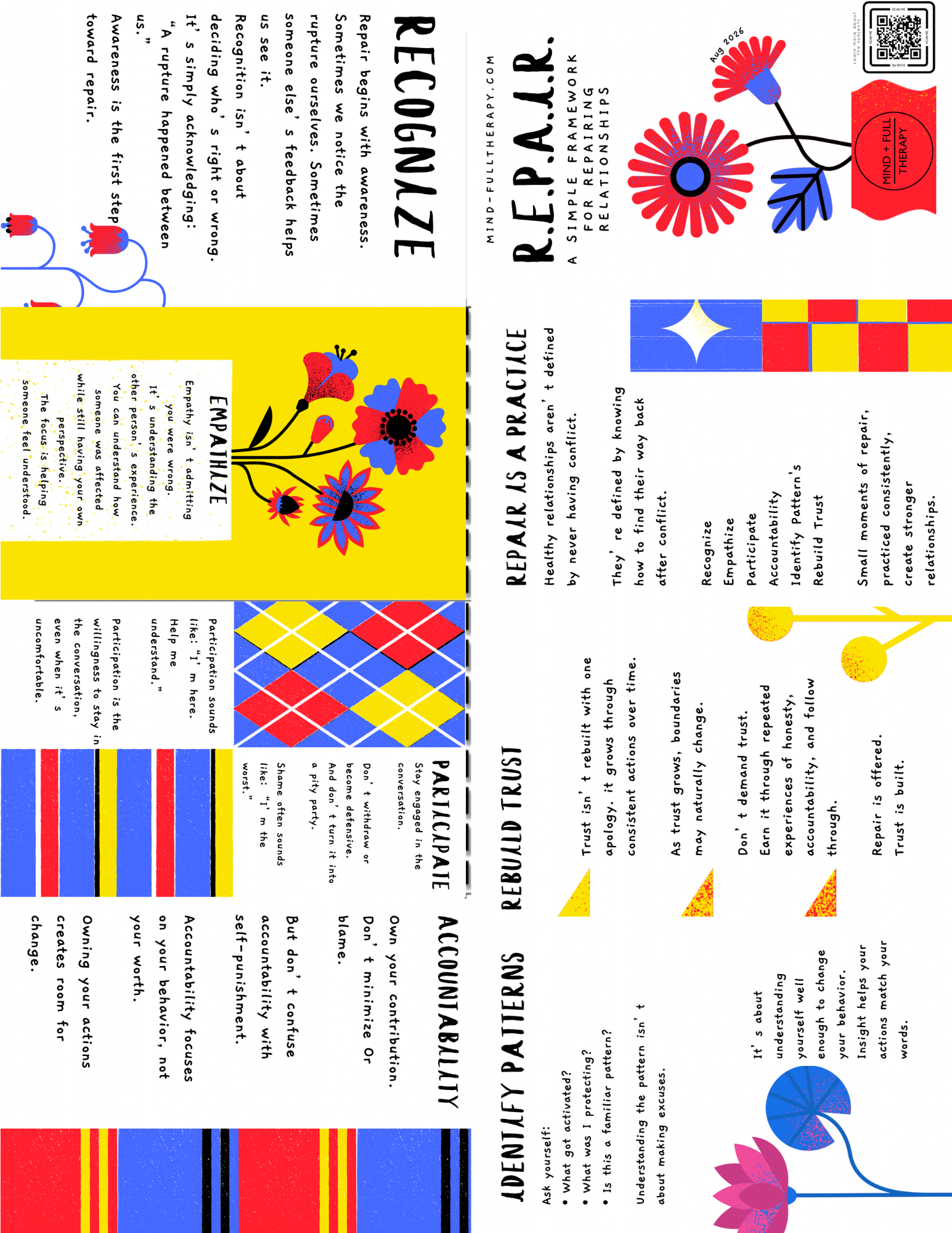
Download the Free R.E.P.A.I.R. Mini Zine
If you’d like a simple reminder of these six steps, I’ve created a free downloadable R.E.P.A.I.R. Mini Zine that you can print, fold, and keep nearby. Think of it as a quick reference after difficult conversations or whenever you find yourself trying to reconnect after a rupture.
Learning Repair Doesn’t Have to Happen Alone
Many of the patterns that make repair difficult didn’t begin in our current relationships. They often developed much earlier as ways of navigating shame, trauma, attachment wounds, or relationships where conflict never felt emotionally safe.
Therapy offers a space to slow those patterns down, understand where they came from, and begin practicing new ways of responding. Over time, those new experiences can reshape how we relate to ourselves and the people we care about.
At Mind+Full Therapy, I work with adults navigating trauma, dissociation, shame, anxiety, depression, and relationship challenges. Together, we explore the emotional learning beneath recurring relational patterns while building greater flexibility, self-awareness, and capacity for connection.
If you’re ready to strengthen your relationships by learning how to repair after conflict, I’d be honored to walk alongside you.
FAQ
-
Relationship repair is the process of reconnecting after conflict through awareness, empathy, accountability, and consistent actions that rebuild trust.
-
Yes. Trust is usually rebuilt through repeated experiences of consistency rather than a single apology or conversation.
-
No. Empathy is the willingness to understand another person’s experience. It doesn’t require abandoning your own perspective.
-
Many people confuse accountability with shame or self-punishment. Healthy accountability focuses on behavior and making meaningful changes rather than condemning oneself.
-
There’s no fixed timeline. Trust develops gradually as someone consistently experiences honesty, follow-through, and changed behavior over time.