
If Your Body Could Leave a Note (Downloadable Pocket zine)
There are a lot of ways people learn to disconnect from their body long before they ever realize they’re doing it. Sometimes it comes from environments where emotions were minimized, dismissed, or treated like a problem. A child learns quickly when sadness creates irritation, when they are told they are being dramatic, and when expressing needs creates conflict. You quickly learn to shifts away from internal experience and toward managing the environment instead. Pattern start to form: keeping things smooth, staying functional and avoiding reactions in other people. Over time, your body becomes less like something you listen to and more like something you work around.
This also gets reinforced culturally. Most people are living inside systems that reward productivity, speed, and constant accessibility. Rest is treated as something earned after exhaustion. Being overwhelmed gets normalized and pushing through becomes a personality trait people admire in each other. There is very little encouragement to pause and notice internal experience unless the body is already in distress. By the time many people begin therapy, they have spent years overriding hunger, exhaustion, tension, grief, anxiety, and emotional overwhelm in order to keep functioning.
The body adapts to this and the focus becomes responsibilities, performance, other people’s expectations, deadlines, staying busy, staying needed, staying productive. Internal experience becomes easier to bypass. Sometimes people can still describe what they feel physically, but there is very little relationship with it. They notice the headache and keep working. They feel their stomach tighten and continue the conversation anyway. They recognize exhaustion and still push themselves past their limits because slowing down feels unfamiliar or uncomfortable.
This is part of why reconnecting with the body can feel difficult at first. People often assume body awareness means having a clear understanding of what you feel. In reality, many people begin with only fragments- a sense of heaviness, restlessness or numbness, or feeling of pressure in the chest. Sometimes there is almost nothing at all besides the awareness that something feels off. That does not mean the body is failing to communicate. It often means the relationship with internal experience has been interrupted for a very long time.
Mindfulness becomes useful here, not because it creates instant calm or perfect self understanding, but because it strengthens the ability to stay present with internal experience long enough to notice it. Most people are used to moving away from discomfort quickly. They distract, explain things away, intellectualize, stay busy, or immediately search for solutions. Mindfulness interrupts some of that automatic movement. It creates space to notice tension, emotion, impulses, and sensations without immediately trying to escape them or turn them into a problem that needs solving.
That process builds familiarity with yourself. Internal experience starts becoming easier to recognize earlier instead of only after reaching burnout, shutdown, or overwhelm. People begin noticing when something feels emotionally unsafe, when they need rest, when resentment is building, when their body is asking for limits, care, or recovery. This is where body awareness begins influencing how someone takes care of themselves. Internal signals start becoming useful information.
Over time, this also creates stronger internal attunement. You begin responding to yourself with more consistency instead of continually overriding what you feel. That might look like setting a boundary sooner, resting before reaching exhaustion, leaving situations that feel harmful, or allowing yourself to acknowledge emotions instead of suppressing them immediately. The body becomes a source of information about your experience.
Once this connection strengthens, people often develop more capacity to explore deeper layers of what the body may be holding. Sometimes physical reactions connect to grief that never had space to fully process. Sometimes chronic tension connects to hypervigilance, fear, shame, or years of bracing against unpredictability. Sometimes numbness itself becomes meaningful. Interpretation can become more useful once there is enough connection in place to actually stay with the experience instead of immediately disconnecting from it.
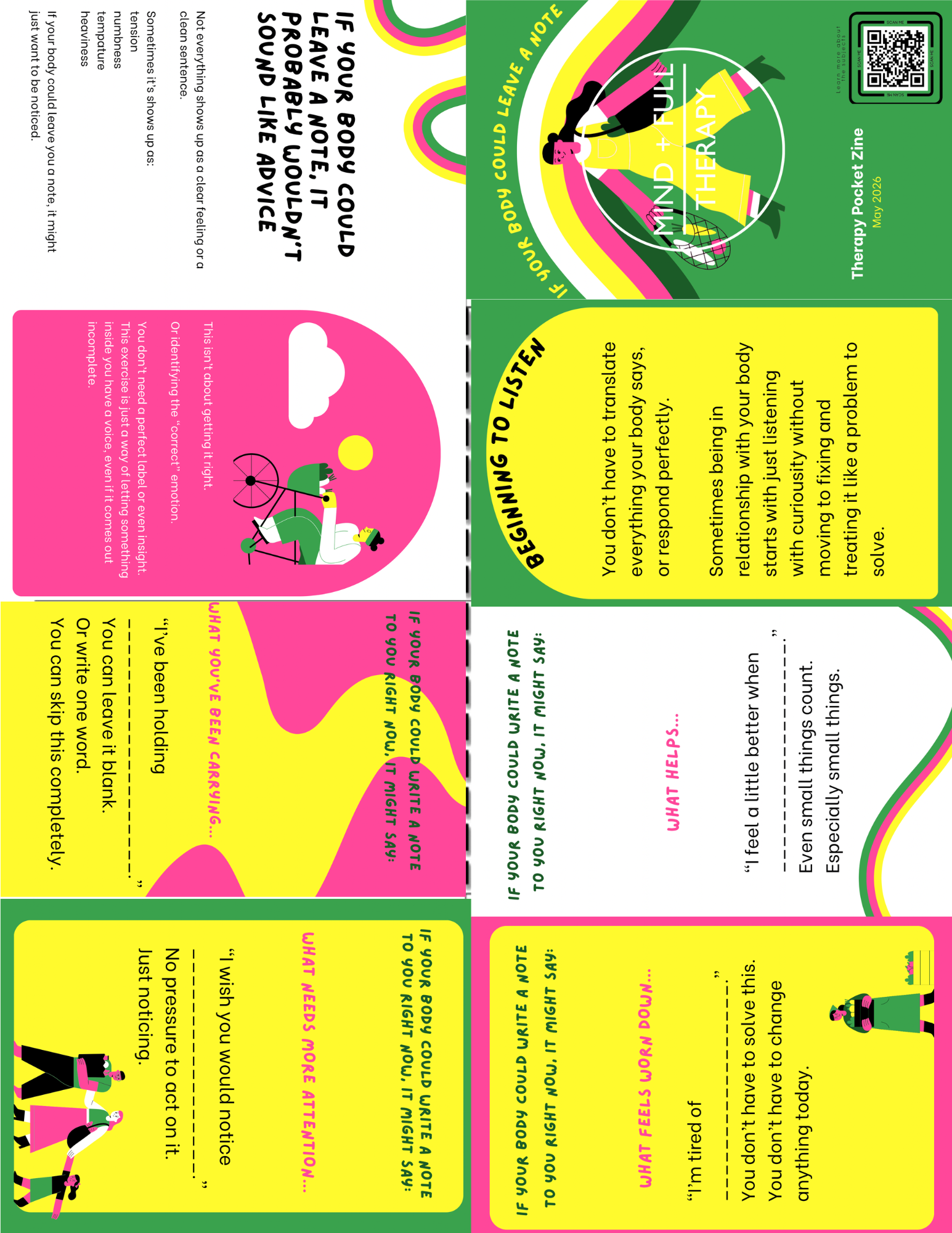
The zine, If Your Body Could Leave a Note, was created as a simple entry point into this process. The prompts are intentionally uncomplicated. They are designed to help people approach internal experience without pressure to analyze themselves correctly. “I’ve been holding…” “I wish you would notice…” “I’m tired of…” “I feel a little better when…” These kinds of prompts give voice to internal experience without demanding certainty or insight. Even a few words can begin creating more connection with parts of yourself that have been ignored, bypassed, or pushed aside for a long time.
If you are interested in exploring this kind of work more deeply, therapy can help create more space for understanding the relationship between your body, emotions, survival patterns, and internal world. At Mind+Full Therapy, we help people move beyond simply understanding their patterns intellectually and toward building a more connected relationship with themselves.