What Are Boundaries and Why Do They Matter? (Downloadable Zine)
Boundaries get mentioned everywhere, therapy sessions, on social media, in conversations about self-care, but that doesn’t mean they feel easy or intuitive. Many of us grew up believing that speaking up for our needs was selfish, that saying no meant letting people down and that a “good” person goes along with what everyone else wants.
I know I did.
Growing up as a little Mormon girl, I learned that love meant giving freely including your time, your energy, your help without asking for much in return. One of the earliest stories that reinforced that idea was The Giving Tree. We were told it was a beautiful message about unconditional love and kindness. The tree gives everything, and we’re supposed to admire that.
But when I became a therapist and reread that story through a different lens, I saw something I had never noticed before: The tree didn’t have boundaries.
And by the end, there was nothing left of her but a stump. The tree was not valued or nourished…just used up.
If the message is love = self-erasure, it teaches children and later adults, that disappearing is virtuous. That saying no is cold. That having needs makes you difficult and that love is proven through depletion.
And that story settles into us.
Of course, we don’t all grow up in the same families, communities, or belief systems, but many people internalize similar ideas. We learn that a “bad” person is the one who speaks up, who says no, who doesn’t go with the flow, who has their own opinions (especially unpopular ones). We learn to survive connection by making ourselves small.
So when someone talks about boundaries, it can feel like the opposite of love. But that’s only because we were taught the wrong version of the story.
The Giving Tree… with Boundaries
There’s a revised version of The Giving Tree that you can find online, where the tree actually expresses limits: I can’t give you my trunk. No, I can’t give you my branches. But here’s what I can give.
The boundaries didn’t come out of anger or punishment, but from a desire to remain whole. And something incredible happens: The relationship improves.
The boy grows into a person who understands reciprocity. The tree flourishes instead of disappearing. They build a connection rooted in mutual care. Love does not require one of them to shrink.
That version reflects what healthy boundaries make possible: connection that honors both people.
So… what are boundaries, really?
Boundaries are how we stay in relationship without abandoning ourselves. They are the point where you’re able to say: “I want to be close to you AND this is what I need to stay well in that closeness.”
They give others a roadmap for how to treat you. They prevent resentment from quietly growing roots beneath the surface. They make your “yes” honest, because you’re allowed to say “no.”
Different Kinds of Boundaries (Explained Like Humans Actually Use Them)
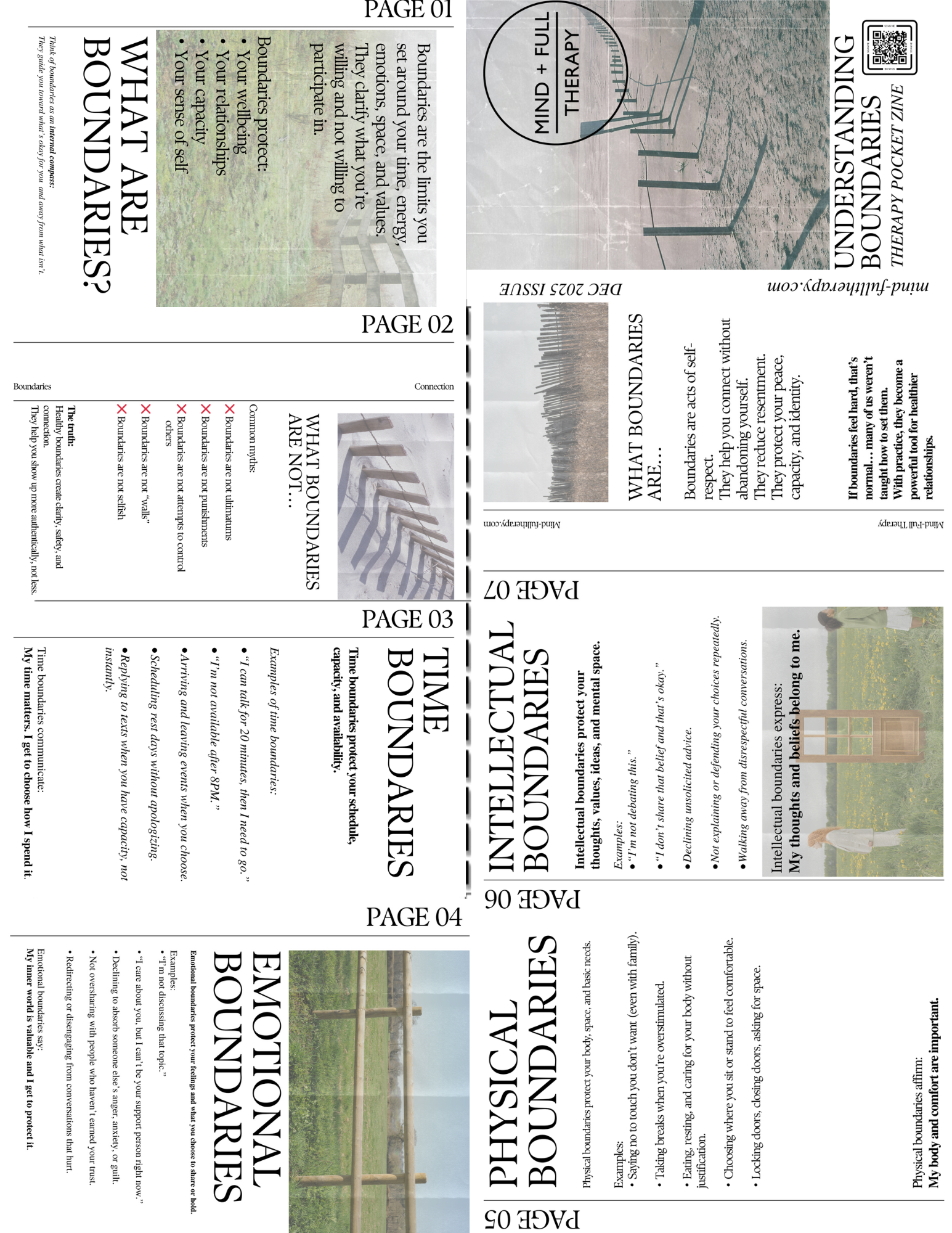
Boundaries show up in more ways than we realize. They can be subtle shifts that keep relationships healthy and grounded. To help make this easier, I created a free Boundaries Pocket Zine.
There are time boundaries, which help you protect your energy and availability. Instead of waiting until you’re overwhelmed, you decide how long you stay somewhere or when you need to head home. You give from a place that feels sustainable.
There are emotional boundaries, which help you care about others without absorbing their stress or being the person everyone leans on all the time. They sound like, “I love you and I can’t talk about this today.” They make care a shared experience instead of a one way street.
Physical boundaries allow you to honor your body and comfort. Adults sometimes forget we still get to choose who we hug, how close someone stands, or when we need a break. Leaving the room to catch your breath is a boundary.
And intellectual boundaries protect your ideas and beliefs. You don’t have to debate someone to justify your existence. You don’t have to explain your choices to earn respect. You get to think your own thoughts, even the unpopular ones.
Each type of boundary serves the same purpose: to help you stay present and connected instead of resentful, depleted and erased.
If boundaries feel uncomfortable at first… that’s normal
Especially if you were raised to be the Giving Tree. Boundaries can feel emotionally loud at first. But discomfort doesn’t mean you’re doing wrong, it means you doing something new! If boundaries feel awkward or overwhelming that’s okay because you’re learning a new skill. Skills become more comfortable with practice and support!
You Are Not Meant to Become the Stump
You deserve to remain standing…rooted, growing, alive.
Boundaries protect the things that make you you. When you know your limits and can express them, relationships have room to breathe, You don’t over function, guess what other people want, or say yes while resentment builds quietly inside. Instead you get to participate in connection as your real, present, honest self.
When you communicate your limits, people who care about you learn how to care for you better. And when someone can’t or won’t honor those limits, that’s important information too!
Healthy boundaries keep you whole so your relationships can grow with you, not at the expense of you.
A Gentle Invitation
If you’re learning how to set boundaries and wrestling with the guilt or fear that comes with it, you’re in the right place. At Mind+Full Therapy, we help people explore their needs, find their voice, and practice connection that supports both sides of the relationship.
We also created a free Boundaries Mini Zine to help get you started with simple language and examples you can use right away. You can download it and read more on our blog and resource page:
Boundaries are not barriers to love, they are invitations to deeper trust.
Download Boundaries Pocket Zine